The UN’s Climate change conference COP26 is taking place in Glasgow, and CILIP in Scotland has put sustainability at the heart of its activities in the run up.
#CILIPSGoGreen has been running since the summer, helping to surface and share sustainability success stories from libraries and information services across Scotland.
Greta Thunberg reminds us, ‘you are never too small to make a difference’, and with a membership of almost 1,200 professionals across Scotland and beyond, every small step taken by a CILIPS member is helping our nation to uphold its environmental responsibilities.
With COP26, the UN Climate Change Conference, taking place in Glasgow until 12 November, it has never been more vital for our profession to play its part in encouraging change, combating misinformation about the stark reality of the climate crisis, and embedding sustainable practices into our ways of working. Inspired by that knowledge [and a rousing keynote delivered to our June 2021 Annual Conference by Bridget McKenzie, Founder and Director of Climate Museum UK,] CILIP Scotland has been running a #CILIPSGoGreen campaign: combining events, blogs, interviews and a (literally) growing resource collection to support LIS professionals as we all seek to expand our environmental consciousness.
Our #CILIPSGoGreen activities so far include:
- Sharing an in-depth video interview with Glasgow Seed Library about the social and environmental impact of their work
- Contributing to the British Library’s National Libraries Now conference video presentation, sharing our views on why libraries are integral to the climate change and sustainability debate
- A video tour of The Nature Library: a pop-up reading space created by artist and writer Christina Riley to connect people with land, sky and sea across Scotland
- Learning from the National Library of Scotland team who designed the Map Images ‘Researching Climate Change’ website space, which includes some vivid visual examples of the impact of human activity on our environment
- A guest blog from Orkney Library and Archive Service about their new electric library vehicle (affectionately known as Baby McBookface, following in the tyretracks of big sibling Booky!)
- An evolving online resource page packed with links to environmentally-friendly libraries around the world, reading recommendations to highlight the critical need for climate action and top tips for small, sustainable changes that can add up to a big difference]
The Climate Challenge and Libraries
by Pamela Tulloch, CEO of The Scottish Library and Information Council (SLIC)
The Scottish Library and Information Council (SLIC) has actively ensured that libraries remain at the heart of the climate debate. Libraries are well placed to lead the way and support the climate agenda within the communities they serve. As the originators of the sharing economy, libraries have demonstrated that community capacity is built on reusing resources and reducing consumption.
As COP26 visits Glasgow, the aspirations of world leaders will confront and tackle the climate emergency. SLIC is working in partnership with a range of organisations to ensure that libraries across Scotland not only adopt the climate agenda, but are also seen as pivotal to support communities with climate challenges both local and global. Two leading initiatives are Climate Beacons and #COP26Conversations.
Climate Beacons
Climate Beacons for COP26 is a Scotland-wide collaborative project between climate change or environmental organisations and arts, heritage or cultural organisations to stimulate long-term public engagement in the lead-up to and following COP26. The project is being led by Creative Carbon Scotland, connecting the seven Beacons and offering support throughout, alongside six co-ordinating partners: Architecture & Design Scotland, Creative Scotland, Edinburgh Climate Change Institute, Museums Galleries Scotland, Scottish Library and Information Council, and Sustainable Scotland Network. Climate Beacons for COP26 is funded by the Scottish Government’s Climate Change and Culture Divisions, Creative Scotland, and Museums Galleries Scotland.
Seven hubs known as ‘Climate Beacons’ are evolving in Argyll, Caithness & East Sutherland, Fife, Inverclyde, Midlothian, the Outer Hebrides and Tayside. Shared resources and knowledge from cultural and climate organisations have been brought together. The Climate Beacons will provide a welcoming physical and virtual space for the public, artists and cultural sector professionals, environmental officers, scientists and policymakers to discuss and debate COP26 themes and climate action specific to each local area.
The Climate Beacons were selected through a competitive application process. The calibre of projects and partnership submissions was extremely high. This demonstrated that Scotland is not only ready to address the climate emergency but actively doing something about it – at scale. The successful Climate Beacons are to be congratulated for their achievement and the opportunity to bring life to their vision.
In particular, the Climate Beacons in Inverclyde and the Outer Hebrides have public libraries at the core, reinforcing the role that libraries have to educate and inform. In addition, libraries are the trusted, safe, spaces in communities where people can come together to debate, learn and collaborate.
Climate Beacons for COP26 will run until July 2022.
#COP26Conversations
Museums and Galleries Scotland (MGS), Historic Environment Scotland (HES) and SLIC have joined forces to make funding available for Museums, Galleries, Historic Environment Organisations and Libraries to host climate conversations and debate in the run up to and during #COP26. While the event is taking place in Glasgow, it is intended for the ‘big’ conversation to take place across Scotland demonstrating that no-one is too small to make a difference and that we are all responsible for the decisions and actions we take.
The #COP26Conversations Fund has been designed to help cultural and heritage organisations begin to raise their profile as spaces for communities to engage with the climate challenge and explore positive actions. The fund encourages fun and creative participation, a chance to connect with the energy that is building in Scotland as the hosts of COP26.
The Fund is being delivered in partnership between Museums Galleries Scotland, the Scottish Library and Information Council and Historic Environment Scotland. It will offer small grants (up to £1,000) to museums, libraries and historic environment organisations to host small scale, community focused events and activities in the build up to and during COP26. A list of the successful recipients for the #COP26Conversations Fund will be published late Summer.
For more information, please see the websites below:
Climate Beacons for COP26
#COP26Conversations Fund for Museums, Libraries, and Historic Environment Organisations in Scotland launched
Scottish Libraries
Inverclyde Libraries – Climate Beacon COP26
by Alison Nolan – Team Leader Libraries
The Inverclyde Beacon is formed of a partnership between Inverclyde Libraries, The Beacon arts centre, Belville Community Garden Trust, RIG Arts, and Inverclyde Men’s Shed, among others. The Inverclyde Beacon will focus on the roles of climate change mitigation and adaptation as part of one of Scotland’s most economically deprived areas’ recovery from Covid-19.
Pre-pandemic and with access to the Public Library Improvement Fund, Inverclyde had spent time 2018-2019 developing their libraries as Cultural Hubs, offering alternative programming. When the pilot was evaluated, it was found that local citizens felt a culture-based library is one that taps into the spirit of the community, assessing priorities and providing resources to support the things deemed most important. One valuable lesson learnt during the pandemic was community spirit and empowerment, as communities rallied together to face the challenges Covid threw at them, and it also cemented the role that libraries play at the heart of those communities. Inverclyde public libraries and the services they offered were havens for community members in a time of uncertainty. Libraries by their very nature are ‘green’ in that their resources are shared by the larger community – Inverclyde’s delivery service, informal online programming, timely access to PCs and support for digital literacy was a priority for the community and crucial during Covid-19.
Being a Climate Beacon in the run up to COP26 is giving Inverclyde Libraries an opportunity to harness this community engagement, offering new and unusual green programs to our communities. Communities need libraries and librarians to act as role models for sustainability by providing accurate information on all manner of green topics. Food security was a huge issue during the pandemic and channelling the established Chatty Café network, the Climate Beacon partnership and creating further partnerships with hospitals, community centres and local citizens, they hope to help create socially sustainable communities. Programming will look at supporting growing food, alternative medicines and concentrate on creating programming to have a lasting impact on their local community, developing relationships that will endure beyond November 2021.
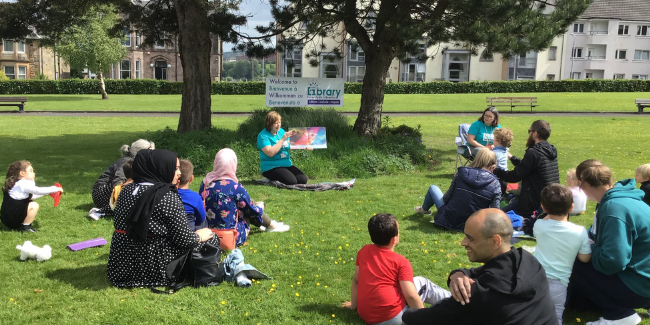
As an introduction to climate focused recovery, Inverclyde has provided a Summer of Fun for children and families. Part of this programming saw libraries deliver 32 outdoor sessions in local parks themed around Wild World Heroes – Summer Reading Challenge 2021 – sponsored by WWF. Some of these activities involved climate themed storytimes and family litter picks – which were a big hit!
For all age ranges, Inverclyde’s Chatty Café network is offering eco exchanges to raise awareness of the impact of climate change and inspire people, young and old, within Inverclyde to take positive action to address the issues it presents. Inverclyde libraries believe, through previous successful programming, that the most effective way to spark conversations is through books, reading, activities and sessions, so concentrating on content from climate-focused writers will provide valuable support for environmental literacy and that eco exchange. They will also focus on the relevant climate issues that are pertinent to Inverclyde – rising water levels and flooding, sources of alternative energy and look at some of the historical materials (maps, drawings etc.) available through the Watt Institution, which sits with Libraries under Cultural Services for Inverclyde.
Along with the new eco exchanges, the gardening Chatty Café will have a focus on sustainability, as will the Chatty Crafters with speakers invited each week to cover [diverse green-themed] topics [such as: grow your own vegetables; environmental issues; nature based solutions; the importance of bees for the environment; nature focused mindfulness session, sustainable fashion and junk journaling. They hope to have a tie in with the Fun Palace Weekend in October 2021. Inverclyde Libraries are also looking at developing some green space at a branch library to create a small community reading garden. Using the expertise from the Men’s Shed and Belville Community Garden they are hoping to engage the local community, volunteers and local schools to help plant and tend the garden. It will be a learning space and the gardening Chatty Café’s Blooms and Biccies will lead the project with support from the Libraries Green Team.
We are looking at this as an opportunity to embed new green practices into our work. Libraries are using the impetus of being a Climate Beacon to write a sustainability strategy and action plan in line with the new Public Library Strategy for Scotland: thus extending the environmental benefit further through both their own sustainable practices, which reduce the environmental impact of day-to-day operations, and being part of the Council’s ‘net zero’ strategy look at green buildings, which seeks to minimize consumption of resources in our buildings and their operation. We have a Libraries Green Team made up of a cross-section of staff who will work on sustainability strategy and action plan and promote green working practices within our libraries, further stimulating climate conversations with their communities.
The hope is that, as Inverclyde recovers from the pandemic, the focus on climate related services, activities, events, literature and projects will demonstrate the social role and responsibility of libraries as leaders in environmental sustainability. The Libraries Team are confident they will inspire their communities into more environmentally sustainable ways of action, and by leading by example, make small changes that offer a discussion forum in the language that their community speaks.
Western Isles Libraries – Climate Beacon COP26
by Kathleen Milne – Libraries Manager
We at Western Isles Libraries feel very privileged to be one of the partners for the Outer Hebrides Climate Beacon. We are working across all the islands in a network, including a number of arts organisations – An Lanntair, Taigh Chearsabhagh and Ceolas – along with Community Energy Scotland, NatureScot, TSI Western Isles, Adaptation Scotland and others. The partnership aims to inspire public engagement and positive action through a range of creative, social and cultural activities and opportunities.
For our part in the Climate Beacon, we are planning a range of activities to help people find out more about climate change, talk about it, share their feelings and help to make a difference. At the heart of these will be establishing Climate Corners at each library, resourced with a range of books for all ages to encourage people to engage with climate change and talk about it with each other. Interactive engagement displays will be created, encouraging people to think about ways to mitigate climate change, as well as adapt to it. We will ask folk to make a pledge, no matter how small, to change something in their lives to make a difference.
It wouldn’t be fair to ask library visitors to make a pledge, without us having to make one as well of course! We are already proud of the fact that libraries are very green, and this is something we should really be shouting about even more at the moment. In the Western Isles, we have pledged to source and provide recycled or ethically sourced paper for our printers and copiers in future. We will also create a shopping list of green stationery and supplies to stick to. Small steps, but each one will make a difference.
Once we have used up our existing supplies of plastic book jackets, we will also make the move to bio plastic film. Unfortunately, the number of books we need to cover ourselves is very small, and we also aim to continue the conversation with major book suppliers to try and find bio alternatives going forward. Hopefully, this is something that all libraries in the UK can get behind!
Our initial ideas for a series of events and activities seems to have grown arms and legs as we get the chance to talk to more people and make new connections. Working closely with Sniffer and Adaptation Scotland has allowed us to link with their adaptation mapping project, which aims to reach as many local residents as possible and ask them to map any changes they have observed caused by climate change, as well as identify other potential impacts which would significantly affect island life. This project launched at Liniclate Library on the Isle of Benbecula and will engage with people across North and South Uist as well through the mobile library service.
We are also working with the University of the Highlands and Islands to create a series of workshops focusing on the environment, biodiversity, the natural world and climate change as part of our existing STEAM Ahead programme. There is already a range of valuable resources available for primary and secondary schools, and so our Climate Beacon activities aim to complement these, and link them to creative activities involving Lego, coding and design.
Books are always at the heart of everything that we do, and so a series of online author events is planned for primary and early secondary schools. So far, we have been lucky enough to get Gill Lewis and Dr Emily Grossman for our initial line-up, and we are still working on expanding that programme to include a few more authors. Linking to these author talks for young people will be a few general talks for communities. These will be offered in partnership with Tigh Innse Gall and will focus on practical ways people can move to greener forms of energy, keeping their homes warmer and doing good for the planet at the same time. Information on green energy will also be distributed to more remote and rural households through our trusty mobile libraries.
Our involvement as a Climate Beacon partner has been a real catalyst for the service. It has helped us to feel far more responsible for helping and facilitating people to engage with the climate emergency, and to facilitate discussions and community working. We feel that our Climate Corners will become very much a core part of our service going forward and will provide the focus for many more conversations.
Banner image: Wild World Wednesdays hosted by Inverclyde Libraries

 Print Page
 Email to a Friend

